If your third graders freeze when they see 456 + 287 or make wild guesses on three-digit subtraction problems, you’re not alone. Teaching fluent addition and subtraction within 1000 is one of the biggest mathematical leaps students make in elementary school. The good news? With the right strategies and plenty of practice, your students can master these skills and feel confident tackling any problem within 1000.
Key Takeaway
Students develop fluency with multi-digit addition and subtraction when they understand place value deeply and practice multiple strategies before settling on efficient algorithms.
Why Number & Operations in Base Ten Matters in Third Grade
Third grade marks a critical transition in mathematical thinking. Students move from primarily working with numbers within 100 to confidently operating within 1000. This shift requires a solid understanding of place value concepts and the ability to apply multiple strategies flexibly.
CCSS.Math.Content.3.NBT.A.2 specifically requires students to “fluently add and subtract within 1000 using strategies and algorithms based on place value, properties of operations, and/or the relationship between addition and subtraction.” The key word here is “fluently” — students need both accuracy and efficiency.
Research from the National Council of Teachers of Mathematics shows that students who master place value concepts in third grade are 40% more likely to succeed in fourth-grade fraction work. This makes sense because both skills require understanding how numbers can be decomposed and recomposed in different ways.
The timing of this standard typically falls in the first quarter of third grade, building directly on second-grade work with addition and subtraction within 100. Students need approximately 6-8 weeks of focused instruction and practice to achieve fluency with these larger numbers.
Looking for a ready-to-go resource? I put together a differentiated addition and subtraction pack that covers everything below — but first, the teaching strategies that make it work.
Common Addition & Subtraction Misconceptions in Third Grade
Understanding where students typically struggle helps you anticipate and address problems before they become ingrained habits. Here are the four most common misconceptions I’ve observed:
Common Misconception: Students subtract the smaller digit from the larger digit in each place value, regardless of position.
Why it happens: They apply the “bigger minus smaller” rule without understanding borrowing.
Quick fix: Use base-ten blocks to physically show what happens when you don’t have enough in a place value.
Common Misconception: Students add or subtract from left to right using the standard algorithm.
Why it happens: They apply reading patterns to math operations without understanding place value.
Quick fix: Teach expanded form strategies first, then transition to the standard algorithm.
Common Misconception: Students think 400 + 300 = 70 because 4 + 3 = 7.
Why it happens: They focus only on the digits without considering place value.
Quick fix: Always connect problems to base-ten blocks or place value charts initially.
Common Misconception: Students believe they can’t solve 500 – 237 because “you can’t subtract 7 from 0.”
Why it happens: They don’t understand regrouping across multiple place values.
Quick fix: Use the “trading game” with manipulatives to build conceptual understanding first.
5 Research-Backed Strategies for Teaching Addition & Subtraction Within 1000
Strategy 1: Place Value Mat Foundation Building
Start every multi-digit lesson with place value mats and base-ten blocks. This concrete foundation prevents students from seeing three-digit numbers as separate single digits and builds the conceptual understanding needed for all other strategies.
What you need:
- Place value mats (hundreds, tens, ones)
- Base-ten blocks (hundreds flats, tens rods, ones cubes)
- Dry erase markers
Steps:
- Have students build both numbers in the problem using blocks on their mats
- For addition, combine the blocks and count the total in each place value
- For subtraction, physically remove blocks and count what remains
- Record the numerical answer after the concrete work
- Discuss what happened in each place value column
Strategy 2: Expanded Form Decomposition
Teaching students to break numbers apart by place value gives them a flexible strategy they can use mentally or on paper. This strategy directly connects to CCSS.Math.Content.3.NBT.A.2 by emphasizing place value understanding.
What you need:
- Anchor chart with expanded form examples
- Individual whiteboards
- Place value cards (optional)
Steps:
- Write the problem: 456 + 287
- Break apart each number: 400 + 50 + 6 and 200 + 80 + 7
- Add like place values: (400 + 200) + (50 + 80) + (6 + 7)
- Calculate: 600 + 130 + 13
- Combine: 600 + 130 + 13 = 743
Strategy 3: Number Line Jumping
Open number lines help students visualize addition and subtraction as movement along a continuum. This strategy is particularly powerful for students who think spatially and need to see mathematical relationships.
What you need:
- Large number line (blank or marked)
- Colored markers or arrows
- Individual number line worksheets
Steps:
- Start at the first number on the number line
- For addition, jump forward by hundreds, then tens, then ones
- For subtraction, jump backward using the same process
- Mark each jump clearly with arrows and numbers
- Land on the final answer
Strategy 4: Mental Math with Friendly Numbers
Teaching students to adjust numbers to create “friendly” calculations builds number sense and computational fluency. This strategy helps students see relationships between numbers and develop flexible thinking.
What you need:
- Chart showing “friendly numbers” (multiples of 10, 100)
- Think-aloud examples
- Student recording sheets
Steps:
- Look at the problem: 298 + 156
- Adjust to friendly numbers: 300 + 156 = 456
- Adjust back: 456 – 2 = 454 (because you added 2 extra to 298)
- Check with another strategy if needed
- Discuss why this method works
Strategy 5: Standard Algorithm with Understanding
The traditional algorithm becomes powerful when students understand why each step works. Introduce this strategy only after students have solid conceptual understanding from the previous methods.
What you need:
- Grid paper or place value columns
- Base-ten blocks for verification
- Step-by-step anchor chart
Steps:
- Line up numbers by place value in columns
- Start with ones place, explaining any regrouping needed
- Move to tens place, including any regrouped amounts
- Continue to hundreds place
- Verify answer using a different strategy or estimation
How to Differentiate Addition & Subtraction for All Learners
For Students Who Need Extra Support
Begin with two-digit addition and subtraction to ensure place value understanding is solid. Provide manipulatives for every problem initially, and use hundreds charts to support counting strategies. Focus on problems without regrouping first, then gradually introduce borrowing with extensive concrete modeling. Consider using graph paper to help with alignment and provide partially completed problems where students fill in missing steps.
For On-Level Students
Students working at grade level should practice all five strategies and begin choosing the most efficient method for different problem types. They should work with the full range of numbers within 1000 and handle both addition and subtraction with regrouping. Encourage them to estimate answers before solving and check their work using a different strategy. Word problems should connect to real-world contexts they understand.
For Students Ready for a Challenge
Advanced students can explore four-digit numbers, work with multiple addends, and tackle more complex word problems involving multiple operations. Challenge them to find the most efficient strategy for different problem types and explain their reasoning. Introduce algebraic thinking by having them find missing addends or work with equations that have unknowns in different positions.
A Ready-to-Use Addition & Subtraction Resource for Your Classroom
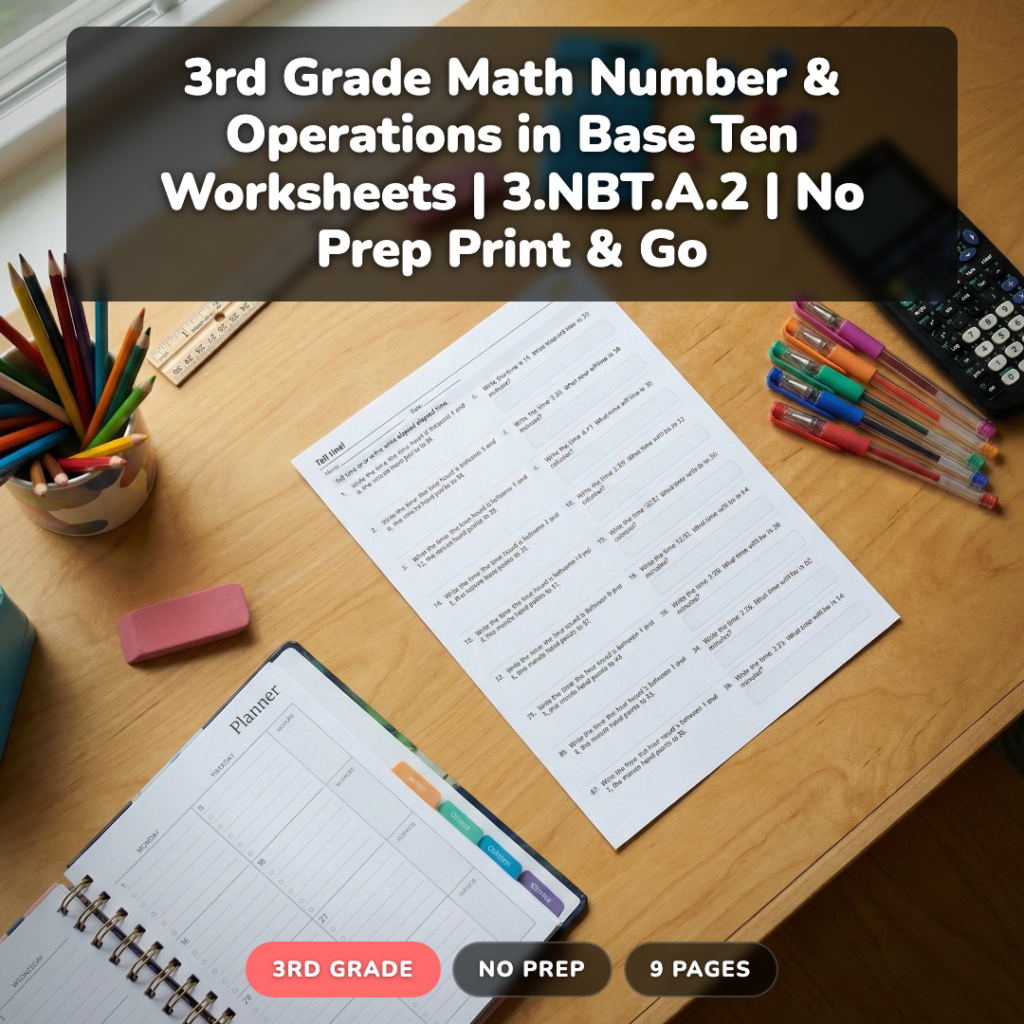
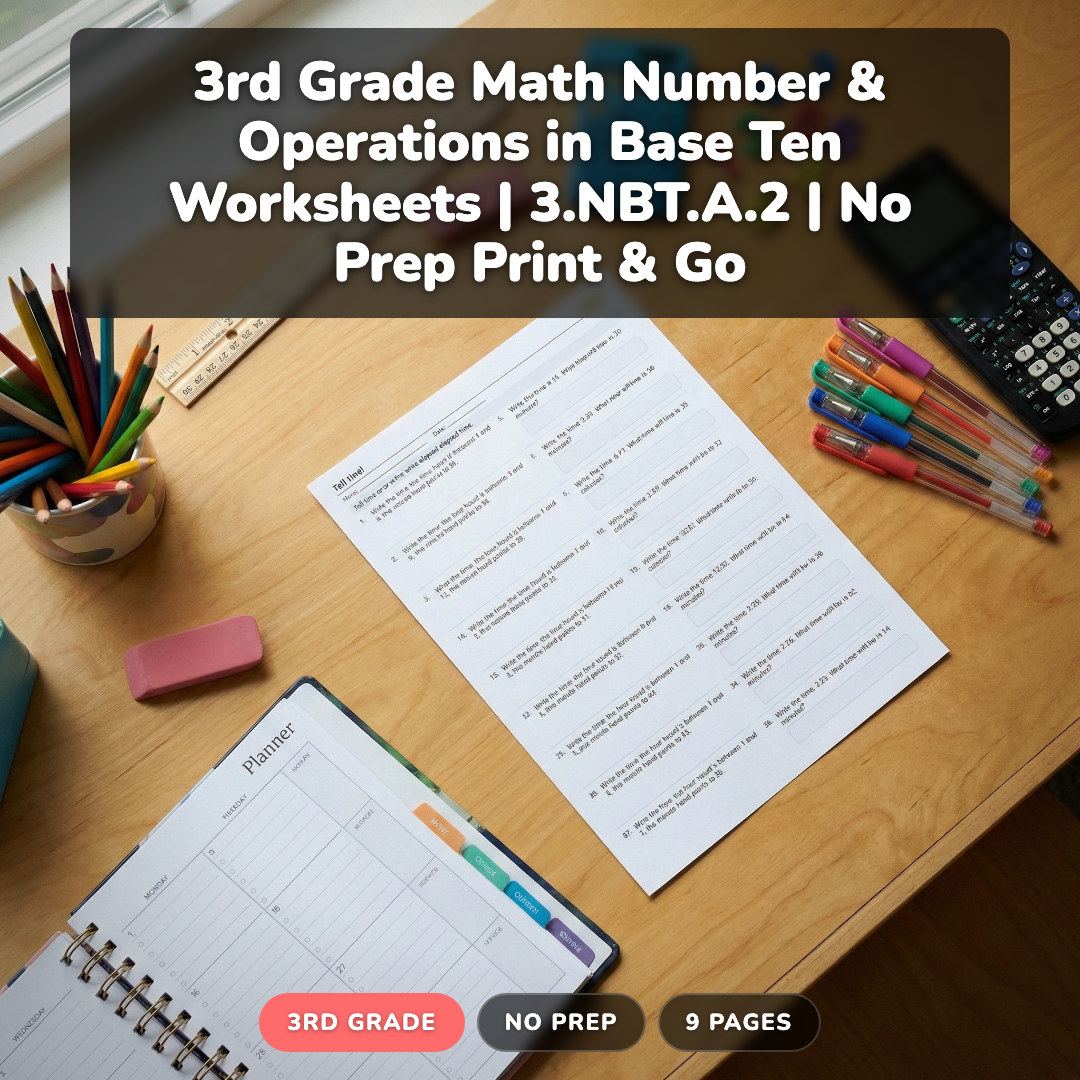
If you’re looking for a comprehensive resource that saves you hours of prep time, I’ve created a differentiated addition and subtraction pack specifically aligned to CCSS.Math.Content.3.NBT.A.2. This 9-page resource includes 132 carefully crafted problems across three difficulty levels.
The Practice level (37 problems) focuses on building foundational skills with scaffolded support. The On-Level section (50 problems) provides grade-appropriate practice with varied problem types. The Challenge level (45 problems) extends learning with more complex scenarios and multi-step thinking.
What makes this resource different is the intentional progression within each level and the inclusion of different problem formats — from basic computation to word problems to number patterns. Each page includes answer keys and can be used for independent practice, homework, or assessment.
You can grab this time-saving resource and start using it tomorrow in your classroom.
Grab a Free Addition & Subtraction Sample to Try
Want to see how these strategies work in practice? I’ll send you a free sample worksheet with problems from each difficulty level, plus a quick reference guide for all five teaching strategies. Perfect for trying out these methods with your class before diving into the full resource.
Frequently Asked Questions About Teaching Addition & Subtraction Within 1000
When should students master addition and subtraction within 1000?
According to CCSS.Math.Content.3.NBT.A.2, students should achieve fluency by the end of third grade. Most students need 6-8 weeks of focused instruction and practice, typically introduced in the first quarter and reinforced throughout the year.
Should I teach the standard algorithm first?
No, research shows students develop deeper understanding when they explore multiple strategies before learning the standard algorithm. Start with place value concepts, expanded form, and number line strategies to build conceptual understanding first.
How do I help students who struggle with regrouping?
Use base-ten blocks extensively and teach regrouping as “trading” — 10 ones for 1 ten, 10 tens for 1 hundred. Practice the trading concept separately before applying it to subtraction problems. Physical manipulation is crucial for understanding.
What’s the difference between fluency and memorization?
Fluency means students can solve problems accurately, efficiently, and flexibly using various strategies. Memorization focuses only on speed and single methods. Fluent students understand why their strategies work and can adapt when problems change.
How much practice do students need to achieve fluency?
Students typically need 15-20 minutes of focused practice daily for 6-8 weeks. Quality matters more than quantity — distributed practice with varied problem types and immediate feedback is more effective than long drill sessions.
Teaching addition and subtraction within 1000 sets the foundation for all future mathematical learning. When students understand place value deeply and can apply multiple strategies flexibly, they develop the number sense needed for fractions, decimals, and algebraic thinking. Remember to start with concrete understanding, provide plenty of practice with different strategies, and celebrate the thinking process as much as correct answers.
What’s your go-to strategy for helping students master three-digit addition and subtraction? And don’t forget to grab that free sample worksheet above — it’s a great way to try these strategies with your class tomorrow.
Looking for more third-grade math resources? Check out my place value activities post for building the foundation skills that make this standard possible.